I have worked with plastic containers for years. I have used them in kitchens, paint projects, farms, and warehouses. One question I get asked often is simple: What is the real difference between a round bucket and an oval one? The answer matters more than most people think. The shape of a bucket affects how you use it, how you store it, how you sell it, and how much it costs you. In this article, I want to walk through every major difference so you can make a smarter choice.
Shape and Structure
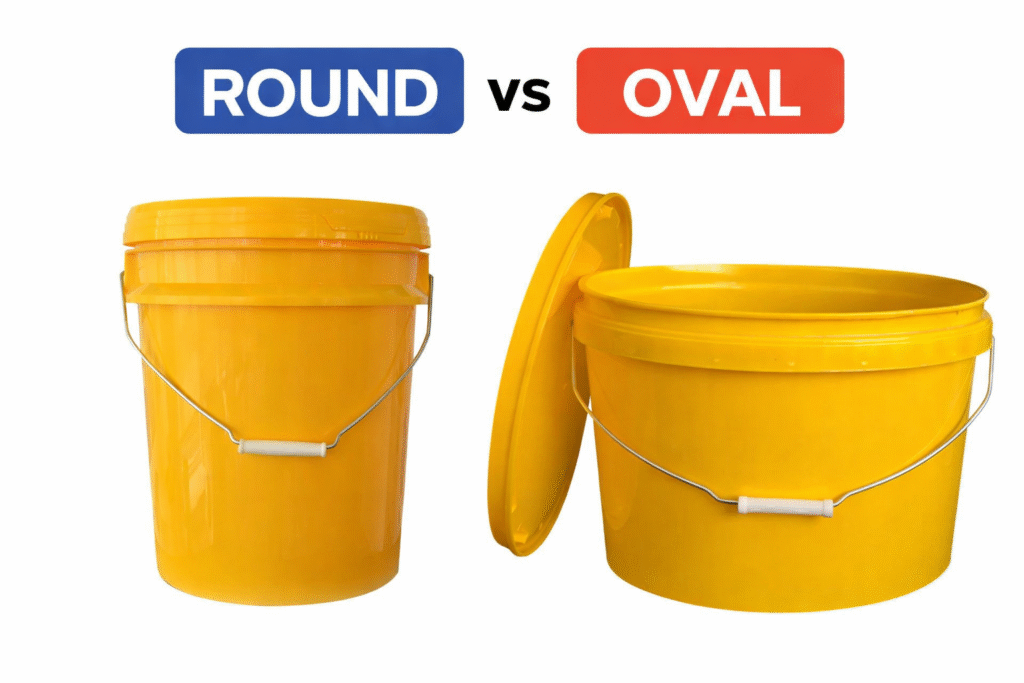
The most obvious difference is the cross-section. A round bucket has a circular opening at the top and a slightly smaller circle at the bottom. This tapered design is called a draft angle. It lets empty buckets stack inside each other. An oval bucket has an elliptical cross-section. The long axis is wider than the short axis. This shape changes almost everything else about how the bucket performs.
Round buckets are very common. You see them at hardware stores, grocery stores, and industrial supply depots. The 5-gallon round bucket is one of the most standard containers in the world. Oval buckets are less universal, but they are growing fast in certain markets. They appear often in paint stores, pet supply shops, and food service settings.
Materials and Manufacturing
Both round and oval buckets are made from the same basic materials. The two most common choices are polypropylene (PP) and high-density polyethylene (HDPE). PP handles heat well. It meets food-grade safety standards. It resists most common chemicals. HDPE is tougher at low temperatures. It absorbs impact without cracking. Both materials are recyclable.
The manufacturing process for both shapes is injection molding. Liquid plastic is injected into a mold under high pressure. It cools and hardens into the finished shape. The difference is in the mold itself. A round mold is simpler. It has a clean, symmetrical geometry. An oval mold is more complex. The die must maintain an even wall thickness around an asymmetrical shape. This increases tooling costs. It also makes quality control slightly harder for oval buckets.
I once visited a plastics factory. The engineer told me that a standard round bucket mold costs about half as much as a comparable oval mold. That cost eventually passes down to the buyer.
Stackability and Storage
Round buckets win in this category. Because they taper from top to bottom, empty round buckets nest inside each other easily. You can stack ten empty round buckets in the space of two full ones. This is a big deal when you ship large quantities.
Oval buckets do not stack as cleanly. Their asymmetric shape makes nesting harder. You can stack them, but the stack is less stable. For this reason, retailers and distributors prefer round buckets when empty container logistics are a concern.
However, oval buckets have their own storage advantage. When they are full and placed on a shelf, their flat oval sides sit flush against each other. They use shelf space more efficiently than round buckets, which leave curved gaps between units. I have seen grocery store managers arrange oval buckets and gain 10 to 15 percent more product on the same shelf. In retail, that kind of space saving is real money.
Handling and Ergonomics
Here is where oval buckets start to pull ahead for many users. An oval bucket fits the hand differently than a round one. When I grip an oval bucket by the body, my fingers wrap around a shape that matches the natural curve of my palm. A round bucket, by contrast, is harder to grip on the side. Most people rely entirely on the handle.
For tasks that require you to dip a tool into the bucket — like painting with a roller, feeding animals, or mixing materials — an oval bucket has a clear advantage. The wide opening gives you more room to move. A standard paint roller fits easily into an oval bucket without scraping the sides. In a round bucket, the fit is much tighter. I switched to oval buckets for all my painting work after one frustrating weekend with a round bucket and a wide roller frame.
The handle design is similar in both types. Both use a wire bail handle that connects to two molded lugs on the sides. The main difference is that oval buckets sometimes place the handle attachment points at the ends of the long axis. This keeps the bucket balanced when you lift it by the handle, even though the shape is not symmetrical.
Lid and Seal Design
Lid design is a practical issue that many buyers overlook until they are standing in a store trying to pry open a bucket. Round buckets most often use a snap-on lid that clicks around the full circular rim. These lids can be tight. You sometimes need a lid opener tool to break the seal. But that tight seal is good for certain applications. Food storage, chemical packaging, and pharmaceutical uses all benefit from a secure, tamper-evident lid.
Oval bucket lids are often easier to open. Many oval lids use a design with two pull tabs on opposite ends. You lift both tabs at once and the lid breaks free. This is more user-friendly. It is especially popular in paint and coating products, where customers need fast access and repeated opening and closing.
Neither design is universally better. It depends on your priority. If you want maximum sealing strength, round is safer. If you want ease of access, oval is more convenient.
Pouring and Content Access
Round buckets pour liquid cleanly. The circular rim creates a consistent edge that controls the flow of liquid in a predictable way. Pouring from a round bucket is easy once you tip it past the center of gravity.
Oval buckets are better for scooping and stirring. The wide mouth gives you full access to the interior. If you are working with thick pastes, chunky solids, or materials that need mixing, the oval shape lets you reach into every corner without tilting the bucket sideways. I use oval buckets when I work with animal feed or thick joint compound, because getting to the material at the bottom of a round bucket always requires me to nearly flip it over.
Industry Applications
I have seen round buckets used across almost every industry. Food manufacturing uses them for sauces, pickles, dough, and dairy products. Chemical companies pack cleaning agents, lubricants, and adhesives in round buckets. Construction crews use them for water, concrete, and debris. The round bucket is essentially a universal container.
Oval buckets have carved out strong positions in specific markets. Paint and coatings is one of the biggest. Ovals are now the standard shape for many premium paint brands. Pet food and animal care is another strong market. Horse owners and farm operators often prefer oval buckets because they are easier to grip and carry with a full arm load. Food service also uses oval buckets for items like cooking oils, condiment pastes, and ready-to-cook preparations.
Branding and Label Space
This is a point that matters a lot to product manufacturers. The surface of a container is prime real estate for branding. A round bucket has a curved surface all the way around. Labels on a round bucket always have a slight curve. You can print directly on the surface or apply a wrap-around label, but the visual result is always a curved presentation.
An oval bucket has two flat sides. Those flat panels are excellent for label application and direct printing. A large, flat label on an oval bucket looks professional and stands out on a shelf. I have seen consumer product companies switch from round to oval specifically to improve the visual quality of their packaging. In-mold labeling (IML) technology works especially well on oval buckets, because the flat surface allows sharp, high-resolution graphics without the distortion that comes from applying a label to a curve.
Cost Considerations
Round buckets are cheaper. The simpler mold geometry means lower tooling costs. The wider production base means more competition among manufacturers, which keeps prices down. Standard parts like lids, handles, and bail hardware are easy to source and interchangeable across brands.
Oval buckets cost more up front. The mold is more complex. Production runs are sometimes smaller. Custom lids and hardware may not be as easily available from third-party suppliers. For small businesses placing their first order of private-label containers, this cost difference can be significant.
However, the cost calculation changes when you factor in retail performance. If an oval bucket helps you sell more product because it looks better on the shelf, the higher container cost may pay for itself. I know a specialty condiment company that switched to oval jars and saw a 20 percent increase in shelf sales in the first quarter. They never looked back.
Environmental Considerations
Both bucket types are recyclable. PP and HDPE are among the most recyclable plastics in the world. Recycling facilities accept both. The main environmental difference between round and oval is in material use. A round bucket achieves its structural strength efficiently through its circular geometry. A circle naturally distributes stress evenly across its wall. An oval bucket must compensate for its asymmetric shape with slightly thicker walls in some areas, which can mean a small increase in material use per unit of volume.
Lightweighting is a trend in both shapes. Manufacturers are engineering thinner walls without sacrificing strength. For oval buckets, this is technically harder because the shape has stress points that round buckets do not. Engineers must be careful not to create weak spots along the long axis of an oval bucket when they reduce wall thickness.
Both shapes are also now available in recycled-content versions. Brands that want to reduce their environmental footprint can source buckets made with post-consumer recycled PP or HDPE. This option is more common for round buckets today, but oval options are growing.
How to Choose the Right Shape
I think the decision comes down to three questions. First, where will the bucket be used? If the answer is a retail shelf or a food service kitchen, oval often wins on ergonomics and branding. If the answer is a construction site or a shipping warehouse, round usually wins on cost and stackability. Second, what will be stored inside? Liquids are easier to manage in round buckets. Thick pastes and solid materials are easier to access in oval buckets. Third, how important is lid security? If you need a tamper-evident seal that cannot be opened without visible damage, round is the safer choice. If ease of repeated opening matters more, oval is better.
My personal rule is simple. I use round buckets when I need to transport, store, or ship. I use oval buckets when I need to work directly out of the container.
Conclusion
Round and oval plastic buckets serve the same basic purpose. They hold things. But the shape is not just a cosmetic choice. It affects grip, access, stackability, shelf presence, sealing performance, and total cost. Round buckets are the reliable, affordable, universal standard. They work in almost every situation. Oval buckets are a smarter choice in specific situations — especially where ergonomics, branding, and user-facing access matter. I believe both shapes have an important place in the market. The key is knowing which one fits your specific need. Once you understand the differences clearly, the right choice becomes obvious.