Quick Answer
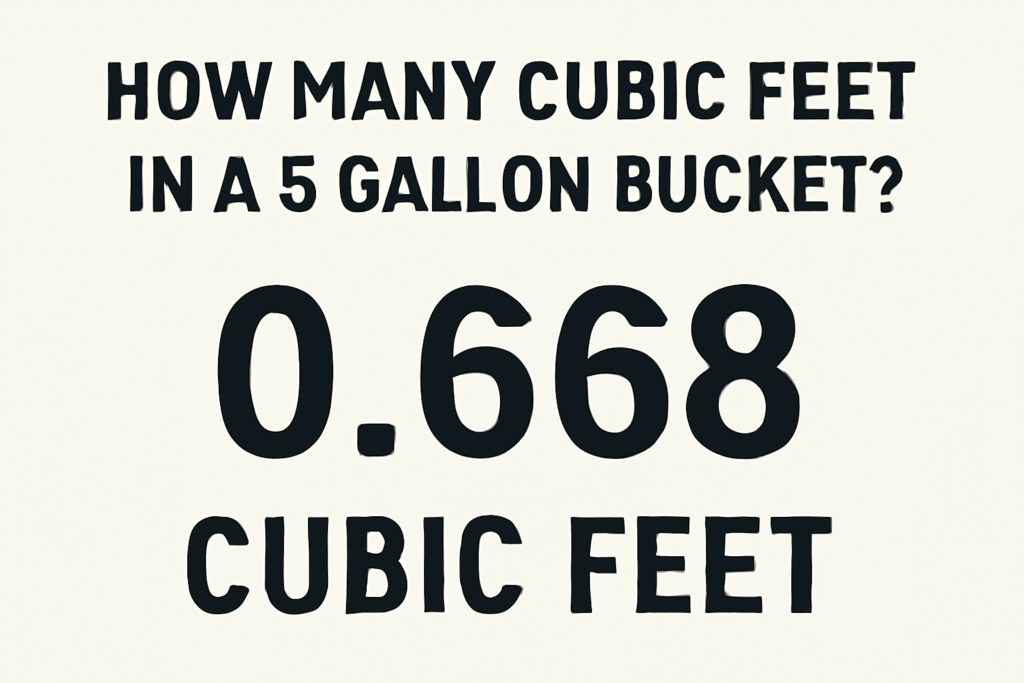
A standard 5-gallon bucket contains approximately 0.67 cubic feet (or 0.668 cubic feet to be more precise). This measurement is essential for various applications, from construction and gardening to DIY projects and storage solutions.
Understanding the Conversion: Gallons to Cubic Feet
To understand why a 5-gallon bucket equals 0.67 cubic feet, let’s break down the math and explore the relationship between these two volume measurements.
The Basic Conversion Formula
The conversion between gallons and cubic feet is straightforward:
1 gallon = 0.133681 cubic feet
Therefore: 5 gallons × 0.133681 = 0.668405 cubic feet
For practical purposes, most people round this to 0.67 cubic feet.
The Reverse Calculation
If you need to convert cubic feet back to gallons:
1 cubic foot = 7.48052 gallons
This means: 0.67 cubic feet × 7.48052 ≈ 5.01 gallons
The slight difference is due to rounding.
Why This Measurement Matters
Understanding the cubic feet volume of a 5-gallon bucket is crucial for numerous practical applications:
1. Construction and Concrete Work
Contractors and DIY enthusiasts use 5-gallon buckets to mix and measure concrete, mortar, and other building materials. Knowing the cubic feet helps calculate:
- How many buckets are needed for a project
- Material coverage rates
- Mixing ratios for concrete and mortar
2. Gardening and Landscaping
Gardeners rely on this measurement for:
- Calculating soil and potting mix quantities
- Determining mulch coverage
- Measuring compost and fertilizer
- Planning container garden sizes
3. Storage and Organization
Understanding volume helps with:
- Estimating storage capacity
- Planning space utilization
- Organizing bulk materials
- Inventory management
4. Painting and Coating
Professional painters use this knowledge for:
- Estimating paint coverage
- Mixing custom colors in correct proportions
- Calculating material costs
Detailed Breakdown: 5-Gallon Bucket Dimensions
To fully understand the volume, let’s examine the typical dimensions of a standard 5-gallon bucket.
Standard 5-Gallon Bucket Specifications
Height: Approximately 14.5 inches (including handle clearance). Useful height: Approximately 12 inches (to the fill line). Top diameter: Approximately 12 inches. Bottom diameter: Approximately 10.5 inches Wall thickness: Approximately 0.1 inches
Why the Tapered Shape?
5-gallon buckets feature a tapered design (wider at the top than the bottom) for several practical reasons:
Stacking efficiency: Multiple buckets can nest inside each other for storage and shipping. Easier removal: Items are easier to remove from a wider opening. Structural strength: The tapered design provides better stability. Demolding: Easier to manufacture and remove from molds
Volume Conversion Table: Quick Reference Guide
Here’s a handy conversion table for various bucket sizes and their cubic feet equivalents:
| Bucket Size (Gallons) | Cubic Feet | Cubic Inches | Liters |
| 1 gallon | 0.134 ft² | 231 in² | 3.785 L |
| 2 gallons | 0.267 ft² | 462 in² | 7.571 L |
| 3 gallons | 0.401 ft² | 693 in² | 11.356 L |
| 5 gallons | 0.668 ft² | 1,155 in² | 18.927 L |
| 6 gallons | 0.802 ft² | 1,386 in² | 22.712 L |
| 7 gallons | 0.936 ft² | 1,617 in² | 26.498 L |
Practical Applications and Calculations
Concrete Mixing: How Many Buckets Do You Need?
One of the most common uses for 5-gallon buckets is mixing concrete. Here’s how to calculate quantities:
Example 1: Small Patio Project
- Project requires: 2 cubic feet of concrete
- Calculation: 2 ÷ 0.67 = approximately 3 buckets
- Result: You’ll need about 3 full 5-gallon buckets of mixed concrete
Example 2: Fence Post Installation
- Each post hole needs: 0.5 cubic feet of concrete
- Calculation: 0.5 ÷ 0.67 = approximately 0.75 buckets
- Result: One bucket can fill approximately 1.3 post holes
Soil and Potting Mix Calculations
Example: Raised Garden Bed
- Bed dimensions: 4 feet × 8 feet × 1 foot deep
- Total volume needed: 32 cubic feet
- Calculation: 32 ÷ 0.67 = approximately 48 buckets
- Result: You’ll need about 48 five-gallon buckets of soil
Example: Container Gardening
- Large planter volume: 2 cubic feet
- Calculation: 2 ÷ 0.67 = approximately 3 buckets
- Result: Three 5-gallon buckets of potting mix will fill the planter
Paint Coverage Estimation
Example: Room Painting
- Standard paint coverage: 400 square feet per gallon
- 5-gallon bucket covers: approximately 2,000 square feet
- Calculation: Room area ÷ 400 = gallons needed
Different Types of Gallons: US vs Imperial
It’s important to note that there are different types of gallons used around the world:
US Liquid Gallon (Standard)
- Volume: 231 cubic inches
- Cubic feet: 0.133681 ft³
- Liters: 3.785411784 L
- This is the measurement we use for 5-gallon buckets
US Dry Gallon
- Volume: 268.8025 cubic inches
- Cubic feet: 0.15556 ft³
- Used for dry goods like grains and produce
Imperial Gallon (UK)
- Volume: 277.42 cubic inches
- Cubic feet: 0.160544 ft³
- Liters: 4.54609 L
- Larger than US gallons
Important: When purchasing buckets internationally or reading specifications, always verify which gallon measurement is being used.
Common Mistakes to Avoid
1. Confusing Liquid and Dry Measurements
Many people mistakenly use dry gallon conversions for liquid volume calculations. Always ensure you’re using US liquid gallon measurements (0.133681 cubic feet per gallon) for bucket calculations.
2. Ignoring Fill Lines
Most 5-gallon buckets have a fill line below the rim. Filling to the absolute top might give you slightly more than 5 gallons, but it’s impractical and messy. Always measure to the designated fill line.
3. Not Accounting for Material Displacement
When mixing materials like concrete, adding aggregate and cement to water doesn’t result in the simple addition of volumes. The materials displace space, so 2.5 gallons of water plus dry mix won’t always equal exactly 5 gallons of final product.
4. Assuming All Buckets Are Exactly 5 Gallons
While called “5-gallon buckets,” slight manufacturing variations exist. For critical applications, verify the actual capacity marked on the bucket.
Professional Tips for Accurate Measurements
For Construction Projects
Tip 1: Use a permanent marker to create measurement lines inside your bucket at 1-gallon intervals for easy measuring.
Tip 2: Keep a dedicated “measuring bucket” separate from mixing buckets to ensure accuracy.
Tip 3: When mixing concrete or mortar, always add materials in the correct order: water first, then dry mix.
For Gardening Applications
Tip 1: Pre-measure and mark soil levels on your bucket for consistent container filling.
Tip 2: Use the bucket weight method: weigh an empty bucket, fill it with soil, and calculate volume based on soil density.
Tip 3: Account for settling: soil settles after watering, so you may need 10-15% more than calculated.
For Liquid Storage
Tip 1: Leave headspace (empty space at the top) to prevent spills and allow for thermal expansion.
Tip 2: Use food-grade buckets (marked with HDPE #2) for storing consumables.
Tip 3: Label buckets clearly with contents and date for safety and organization.
Volume Equivalents: Other Useful Conversions
Understanding how 5 gallons relates to other common measurements:
Cubic Yards
- 1 cubic yard = 27 cubic feet
- 1 cubic yard = approximately 40.3 five-gallon buckets
- Calculation: 27 ÷ 0.67 = 40.3 buckets
Cubic Meters
- 1 cubic meter = 35.3147 cubic feet
- 1 cubic meter = approximately 52.8 five-gallon buckets
- Useful for international projects
Quarts and Pints
- 5 gallons = 20 quarts
- 5 gallons = 40 pints
- 5 gallons = 160 fluid ounces (US)
Bucket Capacity by Material Weight
Different materials have different densities, affecting how much weight a 5-gallon bucket can hold:
Water
- Weight: Approximately 41.7 pounds
- Density: 8.34 pounds per gallon
Dry Sand
- Weight: Approximately 67 pounds
- Varies by moisture content and compaction
Concrete (Mixed)
- Weight: Approximately 100-120 pounds
- Depends on the mix ratio and aggregate size
Topsoil
- Weight: Approximately 40-50 pounds
- Varies significantly by moisture and composition
Gravel
- Weight: Approximately 80-85 pounds
- Depends on stone size and type
Safety Note: Always consider weight when moving filled buckets. Use proper lifting techniques and get help with heavy loads.
Frequently Asked Questions
How many 5-gallon buckets equal 1 cubic yard?
Approximately 40-41 five-gallon buckets equal one cubic yard. Precisely: 27 cubic feet ÷ 0.67 cubic feet = 40.3 buckets.
Can I use 5-gallon buckets to measure cubic yards of material?
Yes, but it’s tedious for large quantities. For accuracy, count buckets carefully and account for settling and compaction, especially with loose materials like soil or mulch.
Are all 5-gallon buckets the same size?
Most standard buckets are very similar, but industrial, food-grade, and specialty buckets may have slight variations. Always check the manufacturer’s specifications for critical applications.
How much does a 5-gallon bucket hold in pounds?
It depends on the material. Water weighs about 42 pounds, while sand might weigh 67 pounds, and concrete can exceed 100 pounds per 5-gallon bucket.
What’s the difference between nominal and actual capacity?
Nominal capacity (5 gallons) is the advertised size, while actual capacity may be slightly more (perhaps 5.3 gallons to the rim). The fill line typically marks the true 5-gallon point.
Conclusion: Mastering Volume Conversions
Understanding that a 5-gallon bucket contains 0.67 cubic feet is more than just knowing a number—it’s a practical skill that applies to countless real-world situations. Whether you’re:
- Mixing concrete for a DIY project
- Calculating soil for your garden
- Planning a painting job
- Organizing storage solutions
- Managing construction materials
This knowledge helps you work more efficiently, estimate materials accurately, and save money by purchasing the right quantities.
Remember the key conversions:
- 5 gallons = 0.67 cubic feet
- 1 gallon = 0.134 cubic feet
- 1 cubic foot = 7.48 gallons
By mastering these measurements and understanding the practical applications, you’ll be better equipped to tackle any project that involves volume calculations. Keep a 5-gallon bucket with marked measurements as a handy reference tool—it’s one of the most versatile measuring devices you can own.